
VOICE ANATOMY
"The singer must know his instrument and at time, how works"
Conseguimos reproducir el sonido gracias a la acci ón coordinada y controlada de ciertas estructuras de nuestro cuerpo que inicialmente,_cc781905-5cde-3194- bb3b-136bad5cf58d_were not designed for such a function.

Thus, we find that our "Sound Production System"
It reproduces with the Vocal Apparatus.
It is amplified by the Resonance Cavities.
It is actuated through _cc781905-5cde -3194-bb3b-136bad5cf58d_of the Respiratory System
It is modified with the Articulation Mechanism.
The sum of these essential elements gives rise to our Vocal instrument
THE VOCAL INSTRUMENT
Functional anatomy of the voice.
We will now see the elements that are part of the producing and emitting process of the voice. It is important that you identify which parts are mobile and which are fixed.

Within the Articulation Mechanism we find that it is formed mainly by the tongue, lips, teeth, maxilla, pavilions or cavities_cc781905-5cde-3194-bb3b- 136bad5cf58d_of resonance, the nose, the hard palate and the soft palate. We have called it this way ya_cc781905-5cde-3194-bbd5cf-158d other organs and muscles, articulating and modifying the sound.
The emitting or producing mechanism, is the set of muscles and organs that includes the larynx, the glottis the pharynx, trachea, lungs, ribs, diaphragm, abdominal and posterior back muscles, as well as the spine itself. They are responsible for the initial basic process of vocal emission.
The resonance mechanism that we will study in more detail refers to the nasal, oral and throat cavities where the vibration emitted through the vocal cords located in la laringe, se amplifican convirtiéndose en sonido, con la calidad y el timbre propios de cada persona.
The whole set of organs, muscles and tissues that we are going to see, form our particular "Vocal Instrument". Getting to know them will help understand how sound is created naturally, transforming the air inspired by the voice that we have known until now.
The mouth
Most of the articulations that characterize and specify the sounds of language are made with the mouth, likewise most of the resonant effects are obtained: the space between the lips and the teeth, the lip cavity, the space between the teeth and the bell... the oral cavity, is without a doubt the main resonator.

In the external part of the mouth we find the lips , they are very mobile and actively participate in the articulation. When the two lips come together or simply get closer, a series of consonants is obtained that we will classify as bilabial (p, b, m) while in the vowels we will speak of rounded (u, o, a) and retracted (i, e) or not rounded. Another type of articulation is produced when the lower lip comes into contact or approaches the upper teeth, the result is the labio-dentals (f, v).
The teeth are passive and serve as a support point for the tongue or lips in the vocal articulation. When the tongue touches the inner face of the upper teeth, the dental apices result, (t, d, n)
The most important organ of speech is the tongue . It is extremely mobile in all its parts, it plays an essential role in the production of melodic timbres, since " it is capable of modifying the resonating effects of the oral cavity with its different movements" .
The joints that result from various movements of the tongue are numerous and varied, depending on the form that it takes, it has the possibility, not only of sliding forwards or backwards, it can also - in its most visible part, become more or less hard, convex, flat, or sunken. For so-called retroflex or cacuminals, the tongue is raised very high with the tip turned backwards (l, r, s).
Also of great importance is the paladar. It represents most of the buccal vault and is divided into two parts. The anterior part or hard palate , which is fixed and extends backwards, and the soft palate or soft palate , which is mobile and ends in the bell or uvula. The joints that are made by a movement of the tongue towards the palate or coming into contact with it are called palatal. The soft palate can make a vertical movement, freeing or obstructing the passage of the expired air into the nostrils. When it remains lowered , the air passes freely both through the mouth and through the nostrils , a resonance cavity where sounds acquire a particular character: nasality . The productions made in this way, consonants or vowels, are called nasals o nasalizadas (m, n, ñ...). If the soft palate is raised , the passage of air to the nostrils is obstructed and the sounds produced are called oral . The bell, located in the extreme part of the palate, is the point towards which the posterior mass of the tongue is raised, producing the sounds called uvular (q, g, k)
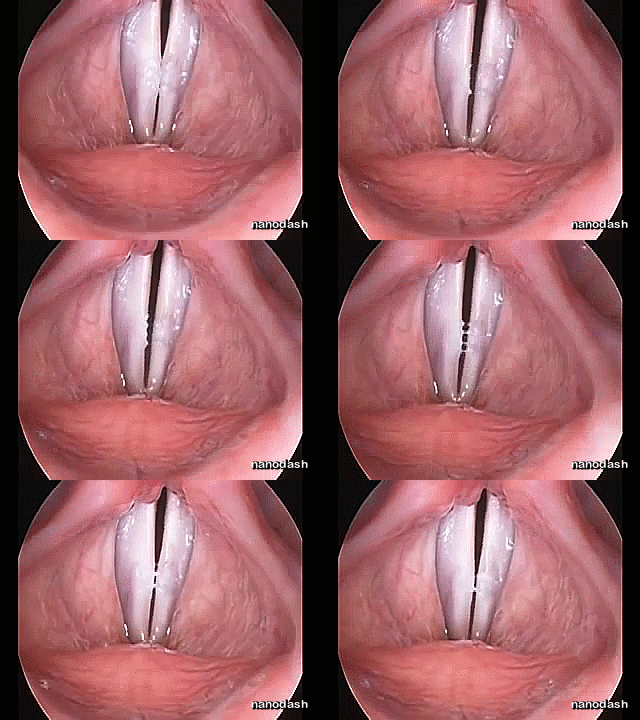
The larynx is located at the top of the trachea and connects to the pharynx. It is the organ producer of sound (counting on the resonance cavities) since in it we find the vestibular folds, also called "false strings" and the vocal folds, small muscles known as "vocal cords" .
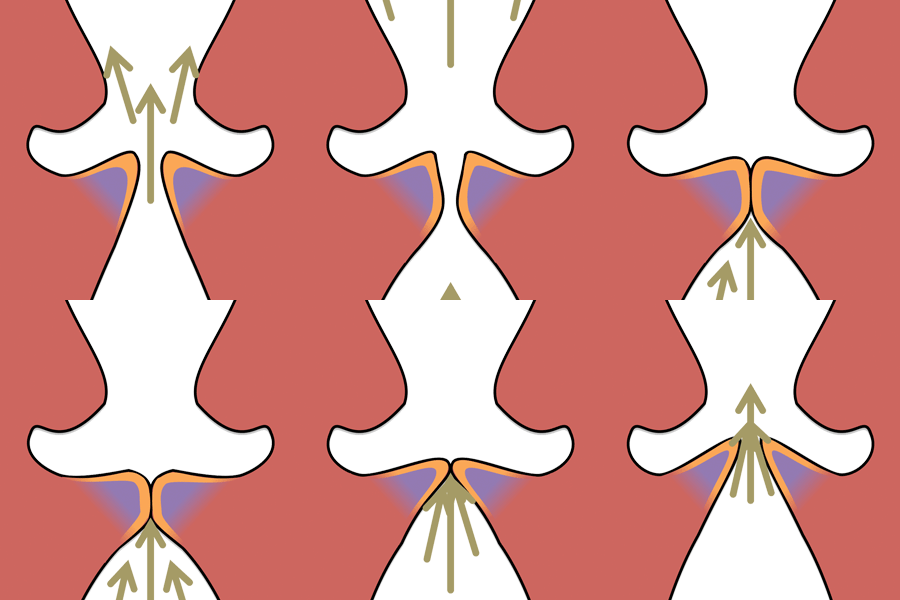
Between the vocal cords we find the glottis, it opens or closes determining the sound. In normal breathing, the glottis opens in the shape of a triangle. During phonation, the vocal cords are brought together with the glottis closed, thus making the cords vibrate, producing the voice._cc781905-5cde- 3194-bb3b-136bad5cf58d_The contraction of these small muscles helps to make them more or less thick, when the vocal cord is relaxed the sound produced is low, when it is tense, the sound is sharp. There are also differences between speakers according to anatomical constitution: women and children, whose vocal cords are shorter and thicker than those of men, tend to have a higher-pitched timbre.
The epiglottis. It forms part of the larynx, although when it rises it is entirely situated in the pharyngeal cavity. It resembles a valve that retracts_cc781905-5cde- 3194-bb3b-136bad5cf58d_backward at the time of swallowing, it forms a lid for the larynx, so that food passes into the esophagus and not into the lungs.
The pharynx. When you open your mouth fully, lowering your tongue, you can perceive, behind the bell, the posterior wall of the pharynx. Its main function is to be one of the main resonators of the vocal apparatus, on the other hand it is the meeting point of the respiratory channels.

Articulation and resonance mechanisms.

Shall we review?

