top of page

RESONANCE AND ARTICULATION MECHANISMS
As we know, sound is produced by the passage of air between the vocal cords located in our larynx.
Resonance cavities allow us to expand our sound flow when we speak or sing. Without them the voice could not be produced as such.
We will deal in parallel with the elements that make up the two systems - Resonance and Articulation, since the same organs intervene and present parallel acts.
These functions take place in the mouth, pharynx and nostrils, with their hard parts and mobile soft parts.
The main Resonators are:
Pharyngeal resonator is the first resonator that finds the sound to be amplified. It corresponds to the area you see at the bottom of your mouth, behind the bell. This communicates directly with the nostrils and with the oral cavity through the tongue and the soft palate. In this way the nasal and oral resonators will be activated.
Nasal or Naso-pharyngeal resonator . It occupies the entire nasal cavity from the nostrils to the back of the soft palate. The nasal resonator is of great importance, very characteristic of black voices. Proper placement creates a lot of nuance in the voice and the well-known "Twang" effect. It helps us project the high notes and the head register. We find it highly promoted in American music, also in styles such as Country and Blues.
Also a marked the original style of singers like Eros Ramazzotti, Alx Rose, Anastacia.
Oral or vocal resonator comprises the entire oral cavity and interacts with the organs responsible for articulation. The tongue is the great interpreter, it is the one that will direct the flow of air and the one that will create the resonance spaces in accordance with the lips, the jaw, the soft palate and the hard palate.
The timbre or quality of each voice is due to the physiognomy of the singer, largely to these hard cavities and their modification by the soft structures.
The resonance of the human voice is produced by a process whose description belongs to acoustic physics.
The difference between the vocal instrument and a musical instrument lies mainly in its flexibility as a live instrument , with the possibility of accommodation in its different moving parts.
The resonators will determine our vocal color and timbre.
This act is also called vocal imposition.
They will help us work on nuances and textures, gain quality and vocal quality, as well as achieve greater projection without the need to push the air or increase the volume of our voice.
Imagine a guitar string sounding without its corresponding resonance box, the same would happen with a grand piano, or a drum. Your soundboard will be crucial in the result of the sound.
To find out a little more about the characteristics of the sound, go to this section.
Each body that vibrates has its own vibration frequency; if they are cavities, their volume, their shape, and the size of their opening relative to the volume will determine their frequency.
Instruments made with recycled materials.


Being the frequency the only one responsible for the height of a tone , the intensity is due to the so-called wave amplitude . This is related to the amount of energy that passes through the sound emitter.
The sounds produced by the human voice are not simple, but compound, creating a series of harmonics that help determine the timbre of the voice .
VOCAL RESONANCE
Any vibration tends to set in motion the elastic bodies that it finds in its path. If the natural frequency of the body in question is the same as that of the vibration, it begins to vibrate as well.
It is the phenomenon of resonance. Thus, any vibrating body that reinforces an existing sound will be called Resonator . The laryngeal sound acting on its own could not be perceived as an acoustic signal.
For this to occur, the singer must learn to voluntarily modify the shape and position of the mobile elements of the vocal tract (pharynx, soft palate, tongue, jaw) and direct the sound towards the different resonators by controlling the pressure of the air column.
Vocal resonance involves, as we have said, the immobile and mobile parts of our anatomy. The first have to do with the vocal characteristics of each person, so that the bone structure of the face provides unique and personal sound qualities.
The second ones allow modifying the internal space of the mouth and the pharynx in such a way that enough space is generated so that the sound is enriched and a correct articulation is produced.
RESONANCE STRUCTURES
Although we have already named them in previous lessons, we will repeat them again to keep them in mind.
The immobile or fixed parts are: The nose and nasal cavity. The hard or bony palate. Upper jaw. Teeth. The maxillary sinuses, on the cheekbones, the frontal sinuses on the forehead, the sphenoid sinus on the bell, the ethmoid sinus next to the eyes. The rib cage at its top.
The moving parts are: Lower jaw, soft palate or soft palate. Pharynx, Oropharynx or isthmus of the fauces. Tongue and lips.
They all contribute to enhancing our resonance. For example the bony or hard palate at the top of the mouth acts as a vault. Direct the sound to that part just behind the teeth and you will notice how the sound changes.
Facial resonators , called in classical song " The Mask". Includes the frontal cavities of the skull, located in the forehead.

HOW TO ENHANCE RESONANCE

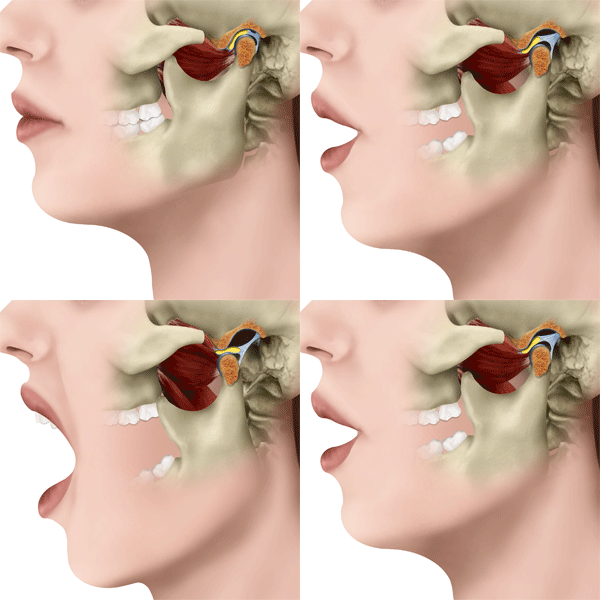
A frequent error is the lack of mouth opening , but not from the lips, but from its base in the jaws.
These should open from the articulation next to the ears in a relaxed way and without forcing, generating a mold in the mouth that allows a rounded opening and a sound rich in harmonics.
Its importance is vital both for the projection of the sound, and to give it intensity.
As there is more space, the sound wave increases.
Sometimes, due to excess tension, the muscles that act in the lifting and lowering movement cause the jaw to move.
This can even cause painful disorders, noises or difficulty in opening the mouth.
These muscles, some elevators and others depressors, are found both in the face and in the neck. That is why we must work with sensitivity in these areas to correct the misuse or improper forcing.
The Oropharynx or Isthmus of the fauces is at the back of the mouth. Its size increases when the soft palate is raised. I recognize that few of my students control this important part during their first classes and so little the one that we will now see.
The tongue is the most active and important of the muscles in the joint. It can bend, retract, vibrate and perform the finest movements. It modifies the oral cavity and of course the quality of the resonance. Its base or posterior part is practically fixed to the hyoid bone and the larynx.
When singing the vowels A, O, U it is particularly necessary that the tongue is flat in the mouth, the tip must be in contact with the lower teeth , being careful not to retract . Any tension that occurs at its base will affect the position and mobility of the Larynx and of course the sound.
If we keep the larynx low , the space in the Pharyngeal resonator (in the throat) will widen and give us improved resonance. It will give us body, amplitude and a coloratura with serious harmonics.
Take care of the vocal attacks, that there is not too much pressure, control your neck and leave the muscles free of forcing.
Remember: lower voltage, higher resonance. Relax and let the sound vibrate, feel its warmth.
bottom of page